REVIEW · IZMIR
Ephesus Small Group Day Tour from Izmir
Book on Viator →Operated by Alaturca Ephesus · Bookable on Viator
Ancient Ephesus starts before breakfast. This full-day small-group tour (max 15) from Izmir mixes major ruins with two spiritual stops and caps it with the Temple of Artemis remains. I like that lunch and entrance fees are built in, so you can focus on the sights instead of the add-ons—though the tradeoff is a long 11-hour day and lots of walking on uneven ground.
You’ll leave Izmir at 7:00 am, ride in an air-conditioned coach, and follow a guide through UNESCO-listed Ephesus. It’s offered in English, and the route is paced so you actually get to look, not just rush for photos.
In This Review
- Key highlights worth planning around
- Early 7:00 AM Pickup: the rhythm of a smooth day
- Ephesus Ancient City: from Arcadian Way to the Great Theatre
- The Celsus Library and Odeon: photo stops with real context
- Temple of Hadrian and the theatre zone: Roman power on Curetes Street
- House of the Virgin Mary: a quiet, symbolic stop above Ephesus
- Isabey Mosque in Selçuk: short visit, noticeable design
- Temple of Artemis: Seven Wonders scale, reduced to one pillar
- Lunch, entrance fees, and the real value of $288.70
- Pacing, walking, and who this small-group day trip suits best
- Should you book the Ephesus Small Group Day Tour from Izmir?
- FAQ
- What time does the tour start in Izmir?
- How long is the Ephesus small group day tour from Izmir?
- Is hotel pickup and drop-off included?
- Is lunch included?
- Does this tour include entrance fees?
- How big is the group?
- Is the tour offered in English?
- Do I need a mobile ticket?
- Can I do this tour if I’m arriving and departing by flight the same day?
- Is free cancellation available?
- Is the tour suitable for most travelers?
Key highlights worth planning around
- Small group, max 15: easier questions, tighter pacing, and more personal guidance.
- UNESCO Ephesus core sights: Celsus Library, Great Theatre, Odeon, Hadrian’s Temple.
- Beyond ruins: House of the Virgin Mary on Bulbul Mountain plus Isabey Mosque in nearby Selçuk.
- Artemis stop, even if small: you still get the story of the Seven Wonders temple and what’s left.
- Value packaging: lunch, professional guide, hotel pickup/drop-off, and entrance fees included.
Early 7:00 AM Pickup: the rhythm of a smooth day
This tour is built around an early 7:00 am start, with hotel pickups from Izmir city centre usually running between 7:00 and 7:30 am. If you’re flying in, airport pickup only works within a specific window, so it’s worth double-checking your flight times.
The practical win here is simple: you’re not trying to sort transport, tickets, and timing on your own. You climb into an air-conditioned vehicle, your guide handles the big-picture story, and you get a structured route that fits an approximately 11-hour day. That structure matters at Ephesus, where the ruins sprawl and the details can blur if you’re just wandering.
One thing to keep in mind: pickup timing can vary based on where you’re staying and how many people are in the schedule. The tour notes that the final pickup time is decided the day before, and they specifically ask you to contact the pickup operator to confirm it. Do that the day before and you’ll start the morning calmer.
You can also read our reviews of more tours and experiences in Izmir.

Ephesus Ancient City: from Arcadian Way to the Great Theatre
If you come to Izmir, Ephesus is the big name for a reason. This UNESCO-listed site is one of the best places in the Mediterranean to grasp what life in an ancient city looked like—especially because it’s so well preserved.
You’ll spend about 2 hours in the Ephesus ancient city area, and that time is guided to help you connect the monuments. The city was a major trading hub and also a center for the cult of Cybele, the Anatolian fertility goddess. You’ll get the Roman angle too: Ephesus was the Roman capital of Asia Minor during its peak around 1 AD to 2 AD.
What makes this stop satisfying is the mix of “big wow” and “how people lived” details. You’ll see things like:
- the Agora (the public heart)
- the marble-paved Arcadian Way
- Public Latrines and Roman Baths (yes, the daily-life stuff)
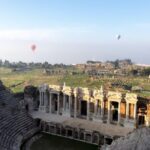
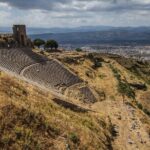
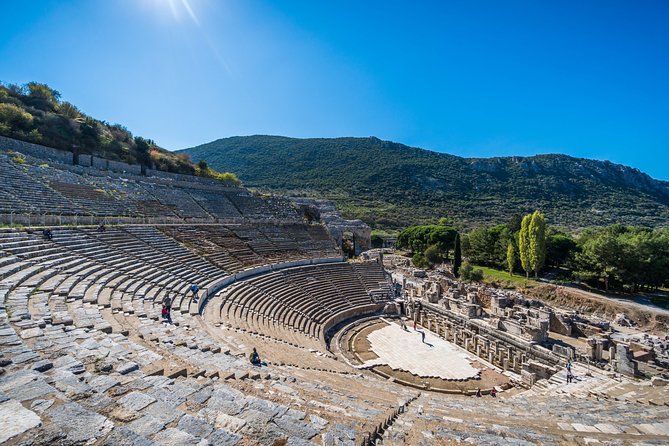
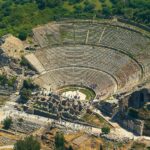
Then comes one of the anchors of the day: the Great Theatre area, where the guide’s context makes the scale easier to understand. The theatre is described as marble, with a width of 145 meters, and it could seat up to 24,000 spectators. In other words, it was built for a crowd that large—so you can’t help but picture the energy of performances and public events.
A small consideration: Ephesus rewards attention, but it also rewards stamina. Plan for steady walking and keep an eye on your footing, especially on stone surfaces.
The Celsus Library and Odeon: photo stops with real context
Two of the most photographed structures in Ephesus are also two of the most meaningful when you know what you’re looking at: the Celsus Library and the Odeon.
The Odeon is a semi-circular theatre originally constructed in the 2nd century A.D. It was financed by Publius Vedius Antonius and his wife Flavia Paiana. You get about 15 minutes here—enough time to take photos and then spot what kind of space it was: not just a performance area, but also a place for political meetings, social events, and concerts.
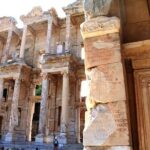
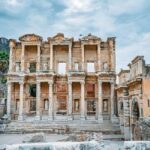
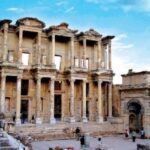
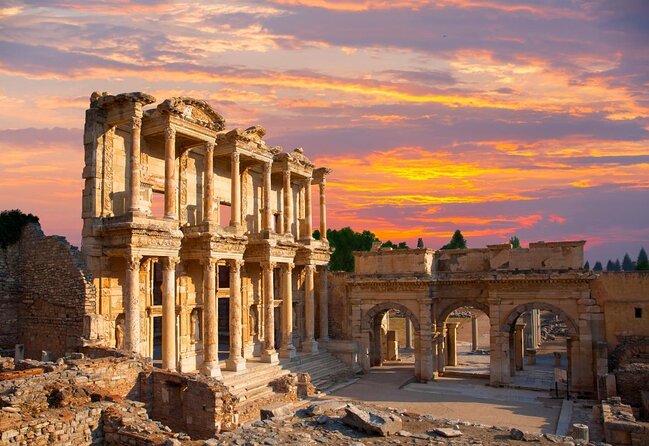
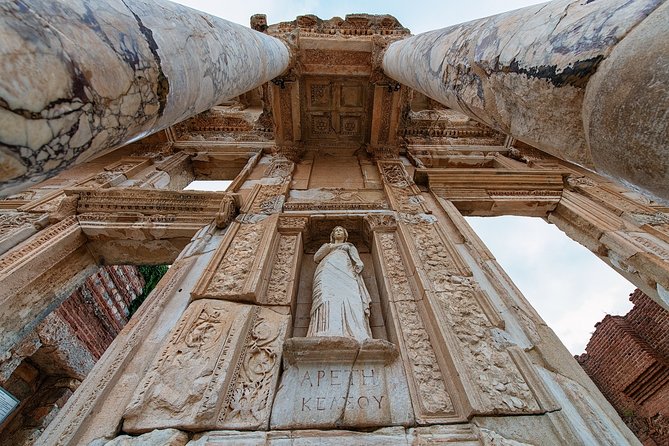
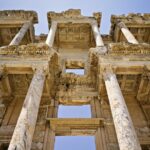
Next is the Bibliothèque de Celsus (the Celsus Library complex), where you get around 20 minutes. This is the “best-known monument” of Ephesus and it’s been extensively restored. The key detail to remember is how it plays with perspective: the facade looks bigger than it is, thanks to a convex facade base heightening central elements, plus larger middle columns and capitals. There are also facade niches with replica statues of the Four Virtues: Sophia (Wisdom), Arete (Goodness), Ennoia (Thought), and Episteme (Knowledge).
That’s the difference a guide makes. Even if the building is “just ruins” to you at first, the story turns the columns and niches into a message about values and learning.
Temple of Hadrian and the theatre zone: Roman power on Curetes Street
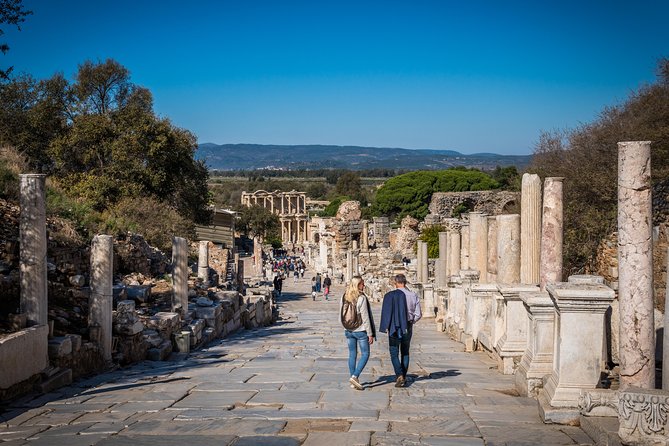
Between the library-and-theatre cluster, the tour includes a short stop at the Temple of Hadrian. You’ll have about 10 minutes here. It’s dedicated to the emperor Hadrian, and it’s described as one of the best preserved and most beautiful structures along Curetes Street. The temple was constructed in the early 2nd century AD by P. Quintilius to celebrate Hadrian’s visit to the city from Athens.
This stop is brief by design, and that’s not a problem if you treat it as a “snap into place” moment. Hadrian’s presence is part of what you see throughout Ephesus: a city that became Roman and then kept layering its identity over older roots.
Then the day continues into the theatre experience itself (about 20 minutes at the Great Theatre stop). The theatre’s size is the headline, but the guided context is what helps it click. A theatre that could hold tens of thousands isn’t just an architectural achievement—it’s proof of how public life worked.
If you want the best photos, stand where you can capture the broad sweep of the seating rather than only the stage area. And yes, the stairs can be slick when they’re worn down.
House of the Virgin Mary: a quiet, symbolic stop above Ephesus
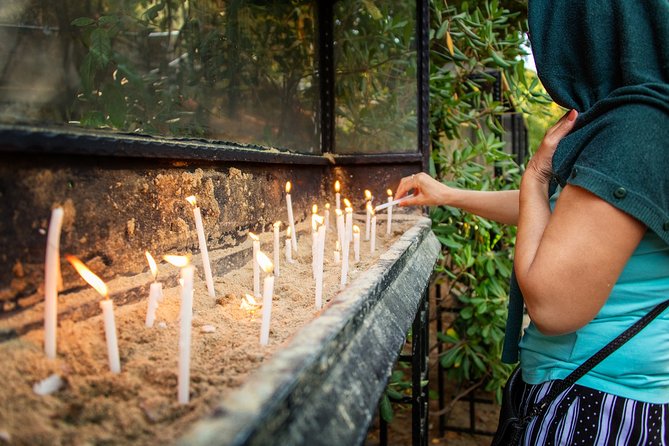
Not every Ephesus day tour includes the spiritual geography of the region, but this one does—starting with the House of the Virgin Mary (Meryem Ana Evi).
You’ll spend about 30 minutes here, and the tour frames it around the belief that Mary, mother of Jesus, spent her final years near Ephesus. It notes she is supposed to have arrived with St. John and lived in Ephesus during roughly 37–45 CE, with traditions differing on what happened afterward (Assumption in Catholic doctrine, Dormition in Orthodox belief).
The house is perched on Bulbul Mountain, so the views and the setting feel part of the experience. Inside, you’ll visit the shrine area and there’s also mention of a spring believed to have healing qualities—so you can choose to reflect quietly there, or just treat it as an interesting local belief.
A practical consideration: this stop is meaningful, but it’s not a museum-style walkthrough. If you prefer strictly archaeological contexts, you might find it slower than the Roman ruins. Still, it adds balance to a day packed with stone and dates.
Isabey Mosque in Selçuk: short visit, noticeable design
After lunch and time in Ephesus, the tour heads to Selçuk for Isabey Mosque. The visit is around 15 minutes, which is enough for an architectural look but not enough for a long, stand-and-stare deep study.
What you’re seeing here is a transitional style: post-Seljuk/pre-Ottoman. The information provided also ties the mosque to its historical context—Selçuk was the capital of the Aydin Emirate. There’s an Arabic inscription above the main entrance stating the mosque was built in 1375.
Why this stop is worth your time: it shifts the day from Roman antiquity to Turkish architectural history without making you spend hours on extra logistics. It’s also a nice rhythm change after long walks through ruins.
If you’re the type who likes to compare styles, use this quick stop to notice how the details feel different from Ephesus stonework. Different centuries, different design priorities.
Temple of Artemis: Seven Wonders scale, reduced to one pillar
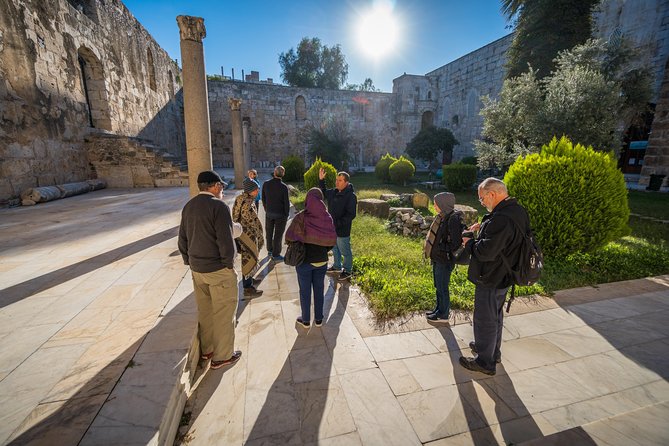
The Temple of Artemis stop is brief, but it’s structured to give you the big picture. You’ll have about 15 minutes at the Temple of Artemis site, also called Artemision.
At its height, the temple counted 127 columns and was one of the Seven Wonders of the Ancient World. Today, what you actually see is limited: the information notes a lone reconstructed pillar remaining in an empty field west of the city’s center.
That can be a disappointment if you’re expecting a full temple to wander through. But with a guide’s framing, it becomes a lesson in scale and loss—how the site’s grandeur is mostly gone, and why archaeology often means reconstructing stories from fragments. It’s also a good final stop because it turns your Ephesus knowledge outward: you start thinking about what the ancient Mediterranean looked like, not just one city.
Lunch, entrance fees, and the real value of $288.70
At $288.70 per person, this isn’t the cheapest way to visit Ephesus. The value question is: what are you getting for that cost?
Here’s what’s included:
- Hotel/port pickup and drop-off
- Air-conditioned vehicle
- Professional guide
- Lunch
- Entrance fees (the itinerary indicates admissions at each stop)
Drinks are not included, including alcoholic drinks, which you can purchase. So you’re budgeting for at least beverages, but the main costs are already handled.
For many visitors, that’s the real advantage. Ephesus is not just a ticketed site—it’s a day plan. Transport plus guided pacing plus admissions usually adds up fast if you try to DIY it. With this tour, you can arrive knowing the big financial surprises are unlikely.
The other value piece is the small-group size. Even if the group doesn’t always fill to 15, the cap matters: you’re less likely to feel like a number in a moving line.
Pacing, walking, and who this small-group day trip suits best
This is a full-day itinerary with multiple stops, so the “fit” depends on your travel style.
This tour makes sense if you:
- want a guided route through UNESCO Ephesus with context
- like big monuments but also want details about daily Roman life
- prefer not to manage transport and entrance logistics yourself
- enjoy architecture and history spanning different eras (Roman, Byzantine-era belief, then Turkish Selçuk history)
It may be less ideal if you:
- dislike long mornings and a sustained 11-hour day
- prefer lots of free time with no schedule at all
- have very limited mobility, since you’ll be moving around ancient areas and walking between multiple sites
A smart planning tip: wear comfortable shoes with grip and dress for sun exposure, since you’ll be outdoors for extended stretches.
Should you book the Ephesus Small Group Day Tour from Izmir?
I think this is a strong pick if you want the classic Ephesus highlights with less hassle. The combination of small-group size (15 max), a guided route through the most important ruins, and built-in items like lunch and entrance fees makes it feel practical for a long day.
Book it if your priority is a guided, efficient day where you can learn what you’re seeing at the Celsus Library, stand in the scale of the Great Theatre, then round it out with the House of the Virgin Mary, Isabey Mosque, and Temple of Artemis story.
Skip or reconsider if you’re traveling slowly and want more free time, or if the early pickup is a dealbreaker for you. In that case, a more flexible option might suit you better.
If you’re on the fence, I’d say the structure is the selling point: it’s built so you don’t have to be an expert to appreciate Ephesus.
FAQ
What time does the tour start in Izmir?
The tour starts at 7:00 am. Pickup from Izmir city centre is usually between 7:00 am and 7:30 am, but your final pickup time is confirmed 1 day before.
How long is the Ephesus small group day tour from Izmir?
It runs for approximately 11 hours.
Is hotel pickup and drop-off included?
Yes. Hotel/port pickup and drop-off are included, and the tour uses an air-conditioned vehicle.
Is lunch included?
Yes. Lunch is included, but drinks are not included (including alcoholic drinks, if you choose to purchase them).
Does this tour include entrance fees?
Yes. Entrance tickets are included for the stops listed on the itinerary.
How big is the group?
The tour has a maximum of 15 travelers.
Is the tour offered in English?
Yes, it is offered in English.
Do I need a mobile ticket?
Yes. A mobile ticket is provided.
Can I do this tour if I’m arriving and departing by flight the same day?
Airport pickup is only available if your flight arrival is between 07:00 and 08:20, and your flight departure after the tour is between 18:30 and 21:50.
Is free cancellation available?
Yes, you can cancel for a full refund up to 24 hours in advance of the experience’s start time.
Is the tour suitable for most travelers?
The tour information says most travelers can participate. Child rates apply only when sharing with 2 paying adults.