REVIEW · KUSADASI
NEW: Private The Most Detailed Ephesus Shore Excursion / with Lunch
Book on Viator →Operated by OTTI Travel · Bookable on Viator
Ephesus in one smooth day. This private shore excursion mixes skip-the-line entry with a Turkish lunch and a smart, expert guide plan that hits the classics plus extra Roman details you usually miss.
I like that it’s truly private, so you can move at your pace instead of getting dragged along with a crowd. I also like how the day is structured around the big sights without turning it into a rushed checklist.
The main thing to consider: the headline price is just the tour cost, and several major site entrances are not included (so bring extra cash or budget for tickets).
If you want a guided day that feels like you’re working from a well-thought-out map, this one fits. Many guides have been praised by name in past experiences, so if you can make a request when booking, consider names like Selin, Nesli, Mehmet, Ahmet, Tas, Asli, Özgür, or Mary.
In This Review
- Key highlights worth your time
- The private advantage for a cruise-day schedule
- Price and logistics: what you pay for the tour vs the sites
- How the day flows: from faith stop to Roman streets
- Stop 1: Meryemana (Virgin Mary’s House) and a quieter kind of awe
- Stop 2: Ancient City of Ephesus with the big visual anchors
- Stop 3: State Agora, where politics and even necropolis stories meet
- Stop 4: The Odeion, a small theatre with big civic use
- Stop 5: Temple of Domitian and the emperor-cult angle
- Stop 6: Hercules Gate and Curetes Street’s pedestrian twist
- Stop 7: Temple of Hadrian, one of Curetes Street’s best-preserved facades
- Stop 8: Terrace Houses, where you feel the domestic side of Roman life
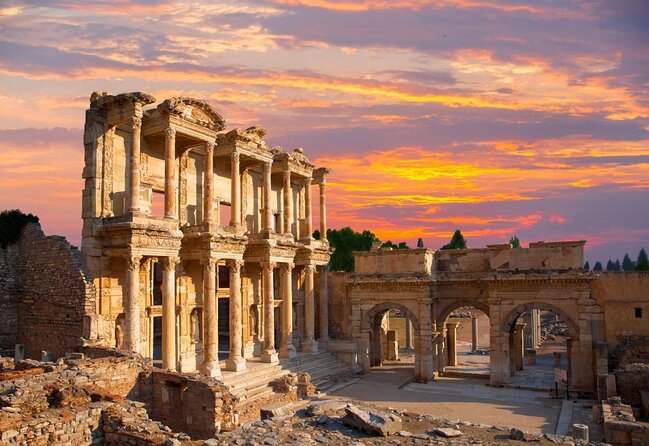
- Stop 9: Library of Celsus, a monumental tomb built like a library
- Stop 10: Ephesus Great Theatre, and why it was more than entertainment
- Stop 11: Temple of Artemis foundations, the Seven Wonders vibe in ruins form
- Stop 12: St. John’s Basilica on Ayosolug Hill, faith and history in one slope
- Lunch at a local restaurant, plus the shopping/rug-making reality check
- What this tour is best for (and who should skip it)
- Should you book this Ephesus shore excursion?
- FAQ
- How long is the Ephesus shore excursion?
- Is lunch included?
- Are entrance tickets included?
- What pickup options are available from a cruise port?
- Is the tour private?
- Can I cancel for a full refund?
Key highlights worth your time
- Skip long lines: guaranteed line-bypass is included, which matters in busy Ephesus seasons.
- Private and customizable: your guide can adjust timing to fit your interests and needs.
- Mercedes air-conditioned van: door-to-door pickup and a comfortable ride from Kusadasi.
- More than the standard hits: State Agora, Odeion, Domitian Temple, Hercules Gate, and Terrace Houses get proper attention.
- Lunch included: you stop for a Turkish meal at a local restaurant; drinks are extra.
- One ticket is baked in: admission for the Ephesus Ancient Greek Theatre is included, but other sites require separate fees.
The private advantage for a cruise-day schedule
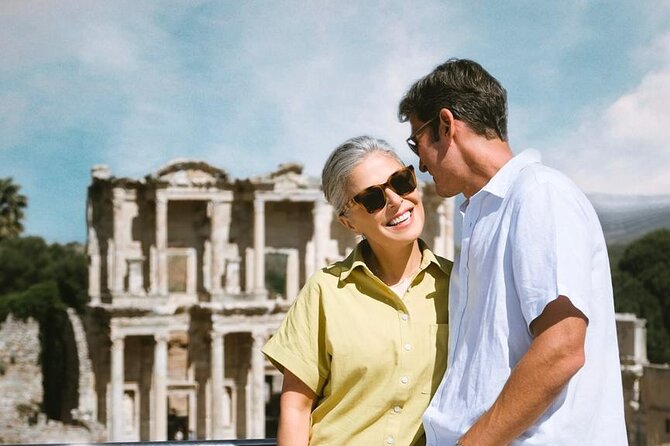
This is built for people who want their day to feel controlled. You get pickup and drop-off, round-trip transport in an air-conditioned Mercedes van, and an English-speaking professional licensed guide. On a shore excursion, that combo is what keeps the day from turning into a timing gamble.
Because it’s private, you’re not forced into a fixed group pace. That sounds small, until you hit the real issue in Ephesus: walking lots of uneven stone, climbing and descending, and trying to read things that were carved for people who lived there. A good guide helps you get your bearings fast, then tells you what you’re seeing and why it matters.
One practical note: this tour is often booked about 88 days in advance on average. If your ship has a limited window or you’re traveling in high season, booking earlier helps lock in the day.
You can also read our reviews of more private tours in Kusadasi
Price and logistics: what you pay for the tour vs the sites
The tour price is $79.20 per person and it covers the guide, transport, parking fees, lunch, and the included theatre admission. But several key sites have separate entrance fees.
Here’s the fee picture you should expect to plan for, based on what’s listed as not included:
- Ancient City of Ephesus: €40 per person
- Virgin Mary’s House (Meryemana): €18 per person
- Ephesus Terrace Houses: €15 per person
- St. John’s Basilica: €6 per person
If you add those together, you’re looking at about €79 extra in entrance fees, plus drinks at lunch. Exchange rates swing, but it’s still the difference between a “cheap day” and a “real full-day experience.” The value comes from the fact that you’re not just buying access—you’re buying guided time, line-skipping, and transportation that keeps you from wasting daylight.
Also check your lunch expectations: lunch is included, but drinks are not. If you want water or something specific with your meal, budget a little extra.
How the day flows: from faith stop to Roman streets
The pacing works because you don’t bounce randomly between far-apart spots. You start at Meryemana (Virgin Mary’s House), then you move into the ancient city core where the walking starts to feel real. After that, the tour layers in Roman-era structures around the main highlights—Agoras, temples, gates—and finishes with the big scenic religious stop on Ayosolug Hill: St. John’s Basilica.
The schedule is also built around “time blocks” that keep your energy reasonable: you’re not stuck at any single monument for hours, but you also don’t get five-minute photo stops. The total duration is listed as 5 to 7 hours, so plan for a full day of activity.
A quick reality check: the tour lists moderate physical fitness. Terrace Houses alone involves climbing and stairs, and you’ll also deal with slopes in Ephesus. Wear shoes you trust.
Stop 1: Meryemana (Virgin Mary’s House) and a quieter kind of awe
You begin at Meryemana, the House of Virgin Mary. The visit is about 30 minutes, and the entrance ticket for this stop is not included.
What makes this stop worth doing (even if you’re not traveling for religious reasons) is the contrast. After the city, Ephesus can feel like pure archaeology—stones, columns, and scale. Meryemana is a different mood: a calmer place where you slow down and look around before the harder walking begins.
Drawback to plan for: because the fee is separate, you’ll want to ensure you have the cash or card access you’ll need without scrambling at the last second.
Stop 2: Ancient City of Ephesus with the big visual anchors
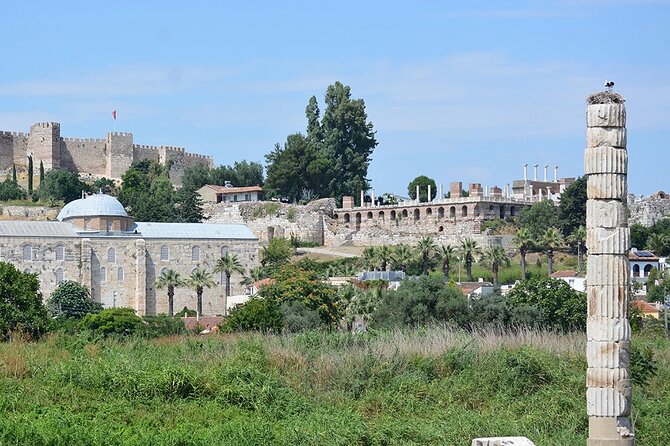
Next you enter the Ancient City of Ephesus, with about 2 hours allotted for this central zone. The city entrance fee is not included.
This is where the architecture and city planning start to click. You’ll pass:
- Harbour Street and the theatre area you’ll revisit later
- Marble Street
- Celsus Library
- The Gate of Mihridates and Mazes
- Commercial Agora, latrina, and the Hadrian Temple area
- Scolastica Baths, Trajan Fountain, and Curetes Street
- Polio Fountain, Memnius Monument, Temple of Domitian, Prytaneion
- Odeon and the State Agora region
A key value here is how much ground the tour covers without making you feel lost. A guide helps you connect streets to functions—what people did there, how the city worked, and why certain monuments were built in the shape they are.
The one consideration: two hours inside a large ancient site can still feel like sprinting if you try to rush everything. If you care about photos, pick one or two “must-capture” spots and let the rest be for seeing in person.
A few more Kusadasi tours and experiences worth a look



Stop 3: State Agora, where politics and even necropolis stories meet
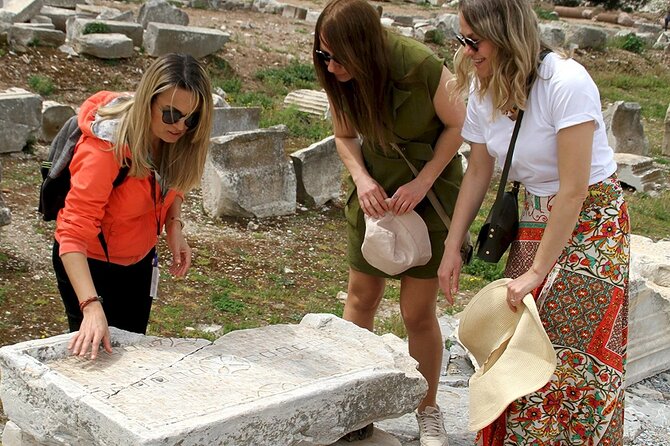
You get a focused 15-minute stop at the State Agora. Entry is not included for this stop.
Here’s what this place tells you about Ephesus beyond the famous tourist icons. This agora wasn’t for shopping. It was tied to business of government and discussion. During excavations, archaeologists found graves from the 7th–6th centuries B.C. and an older stone-paved road. There was even evidence that this part of the Agora served as a necropolis in the archaic period.
Then there’s the water story: you’ll hear about a water reservoir at a corner of the Agora, supplied through the Pollio Aqueduct, whose remains are visible about 5 kilometers away. Even a short stop here adds depth to what you see elsewhere—Ephesus wasn’t just impressive. It was practical.
Stop 4: The Odeion, a small theatre with big civic use
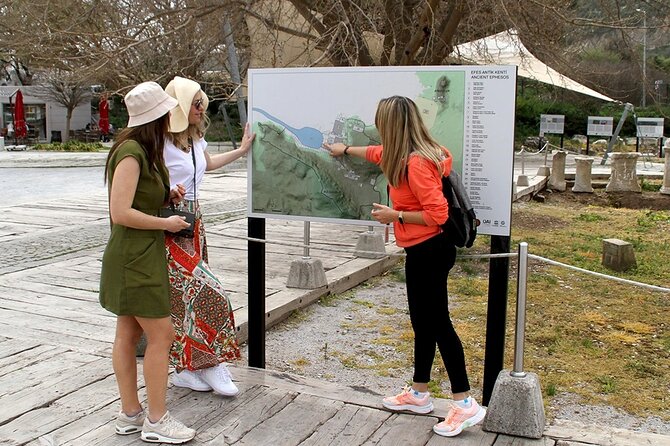
The Odeion is another “why doesn’t every tour stop here?” moment. You’ll spend about 15 minutes.
This building was shaped like a small theatre, with seating and a stage area. It had a double purpose:
- Meetings of the Boules or senate as a Bouleuterion
- Performances as an odeum, basically a concert hall
Capacity was listed at around 1500 spectators, and it was built in the 2nd century A.D. If you like understanding how Roman cities used space, this stop is a win.
Stop 5: Temple of Domitian and the emperor-cult angle
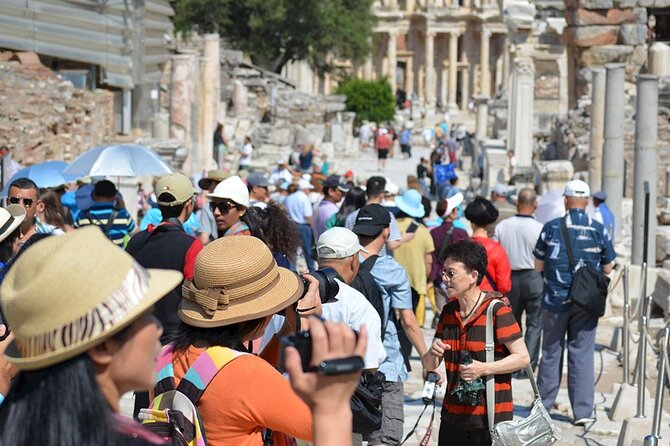
You’ll visit the Temple of Domitian in about 15 minutes. Admission is not included.
This temple matters because it’s the first known emperor-dedicated structure in Ephesus. The location and build technique are impressive even in ruins: it sits on a high terrace measuring about 50 x 100 meters, with vaulted foundations and stairs that are still visible.
Architecturally, it follows a pro-style plan with columns on all the main sides, and there’s mention of an altar on the northern side now displayed in the Izmir Museum. There’s also that important political honor detail: in Domitian’s reign, an emperor granted permission for an Emperor Temple—linked to the city being awarded the honor of neocoros for the first time.
Downside: it’s not a “stand under and wow” stop for everyone. Some people prefer more interactive spaces. If you like understanding power structures, you’ll enjoy it.
Stop 6: Hercules Gate and Curetes Street’s pedestrian twist
You’ll take about 15 minutes at Hercules Gate, with admission not included.
This gate gets its name from a relief of Hercules. Only parts of the columns remain, because other sections haven’t been found. There’s also a theory connecting the relief of flying Nike in the Domitian Square to this gate.
The practical “city-life” detail I liked here: the gate helped narrow access to Curetes Street, keeping vehicles from passing—suggesting that by the 4th century, the street had become a pedestrian area. That’s the kind of information a good guide gives: it helps you picture how people moved, not just what stones exist.
Stop 7: Temple of Hadrian, one of Curetes Street’s best-preserved facades
You get about 10 minutes here, and the entrance fee is not included.
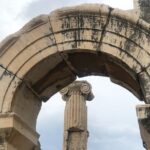
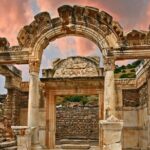
Among what you’ll see on Curetes Street, the Temple of Hadrian is described as one of the best-preserved and most beautiful structures. It was built before 138 A.D and dedicated to Emperor Hadrian, tied to his visit in 128 A.D.
Look for the front design: four Corinthian columns supporting a curved arch. The middle relief features Tyche, the goddess of victory. The pedestal area is also tied to later emperors, with statue bases mentioned between 293–305 CE.
If your time is tight, this is a good one to focus on visually. A short visit is enough to appreciate the facade if you know what to look for.
Stop 8: Terrace Houses, where you feel the domestic side of Roman life
This stop is about 30 minutes at the Ephesus Terrace Houses. Entrance is not included.
This is where Ephesus stops being just public monuments and turns into daily life. These houses belonged to wealthy Romans, arranged across terraces on the hillside opposite Hadrian Temple. The tour notes that they were built on an Hippodamian plan, with roads at right angles—so city planning shows up in the layout.
The houses span multiple eras: the oldest building is dated to the 1st century B.C, and the residences continued into the 7th century A.D. Protective roofing covers the area, and you’ll see consolidated mosaics and frescos. Two houses are opened as a museum.
Big practical consideration: stairs. If you don’t like climbing, you’ll still likely manage it, but it’s not a couch-and-wander stop. Wear supportive shoes and take your time.
Stop 9: Library of Celsus, a monumental tomb built like a library
Next is the Library of Celsus, about 30 minutes, with admission not included.
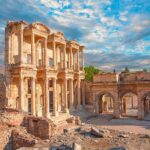
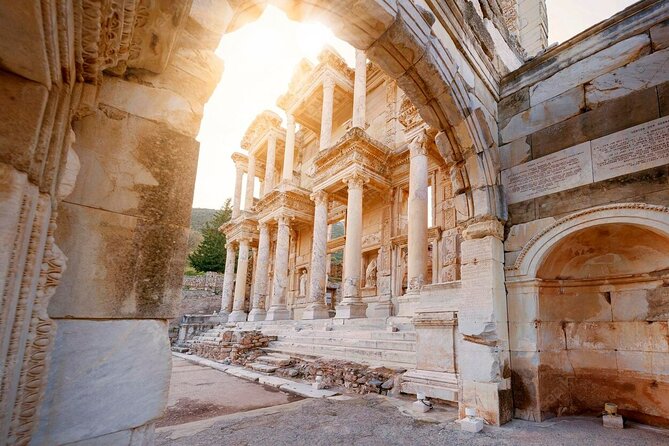
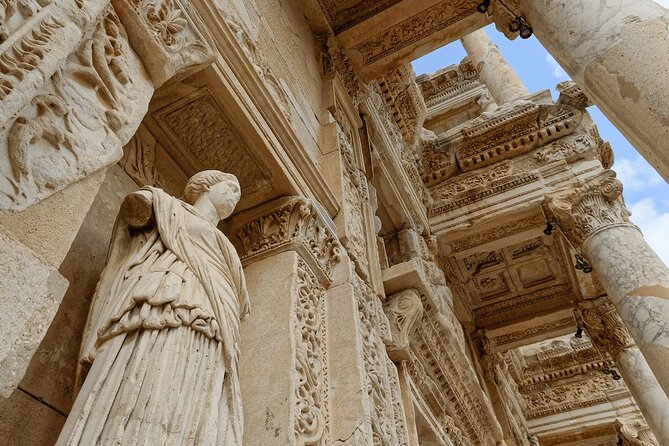
Even if you’ve seen photos, this library hits differently in person. It was built in 117 A.D and served as a monumental tomb for Gaius Julius Celsus Polemaeanus, with burial details underneath the ground floor and a statue connected with Athena.
Here’s what I’d tell you to look for: the library design was built to protect scrolls. The description notes cupboards in wall niches and double walls behind the bookcases to control temperature and humidity. Capacity was listed at over 12,000 scrolls, which helps you understand the scale of what Rome preserved here.
This is also a great example of how archaeology tells stories. It’s not just a pretty facade; it’s a storage system, a memorial, and a statement about knowledge.
Stop 10: Ephesus Great Theatre, and why it was more than entertainment
You’ll spend about 25 minutes at the Ephesus Ancient Greek Theatre, and this stop is listed as admission included.
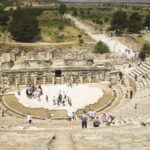
The numbers are the headline: it’s described as the largest in Anatolia, with capacity about 25,000 seats. The seating is divided by diazoma walkways into sections, and the cavea has 66 rows.
The real value is the use-cases. This theatre wasn’t only for plays and concerts. It also hosted religious, political, and philosophical discussions, plus gladiator and animal fights. That mix helps you understand how ancient public space worked: entertainment, authority, and belief all shared the same stage.
If you’re sensitive to crowds, you can still enjoy it here because the guide helps you time the viewing and keep your walk efficient.
Stop 11: Temple of Artemis foundations, the Seven Wonders vibe in ruins form
You’ll visit the Temple of Artemis for about 40 minutes. Admission is not included.
The famous detail: it’s known as one of the Seven Wonders of the ancient world. But what you’ll see today are foundations—the site turned into swamp over the centuries. The best preserved pieces you might recognize from museums are noted as being displayed at the British Museum.
This stop can feel anticlimactic if you expect a full temple standing. But it works when a guide frames it: you’re not touring a ruin. You’re touring what remains of a monument that was once entirely marble and heavily sculpted.
Stop 12: St. John’s Basilica on Ayosolug Hill, faith and history in one slope
The final major stop is St. John’s Basilica, about 40 minutes, with admission not included.
The background is tied to tradition: it’s believed the evangelist John spent his last years in the region around Ephesus and was buried on Ayosolug Hill. A small chapel was built over the grave in the 4th century, then later expanded into a basilica during Emperor Justinian’s reign (527–565 AD).
If you’re interested in how empires and religions change over time, this is a strong ending. You started with a house linked to Mary, moved through Roman power, and finish with a basilica tied to early Christianity.
Lunch at a local restaurant, plus the shopping/rug-making reality check
Lunch is included, and it’s one of the things people consistently talk about in a positive way. The vibe is meant to be local rather than cafeteria-style, and it’s a proper break from the stone marathon.
Two practical notes:
- Drinks at lunch are not included, so plan on buying water or soft drinks if you want them.
- There can be a shopping component after lunch in some formats, including carpet weaving or rug-making displays. People often find the rug sales pitch a bit pushy at first, but the overall tone tends to depend on how you respond. If you do not want to buy, you still can learn about the craft without getting swept into a hard sell.
A nice touch some guides add is helping you taste local items like figs, and you may hear about pomegranate juice being part of the experience. If you’re the type who likes little food moments, that’s a pleasant bonus.
What this tour is best for (and who should skip it)
This tour is a great fit if you:
- Want a private Ephesus day with a real guide and air-conditioned transport
- Like seeing both the big icons and the “in-between” stones like Odeion and the State Agora
- Prefer structured time blocks over wandering on your own
- Are okay paying separate site fees to avoid long lines and gain guided context
It’s less ideal if you:
- Hate crowds and long walking, because even with good pacing, Ephesus is a large site
- Want everything fully included with zero extra fees, because several major entrances cost extra
- Don’t want any shopping stop at all, since some days include carpet or rug-related stops
Also remember: the tour lists moderate physical fitness. Terrace Houses means stairs, and the slopes around Ephesus do their own math on your energy.
Should you book this Ephesus shore excursion?
I’d book it if your priority is a well-run day: private guide attention, comfortable Mercedes van pickup/drop-off, and skip-the-line access that saves you time in Ephesus. The value improves a lot when you factor in the guide work, the included lunch, and the fact that theatre admission is included, even if other sites still require separate tickets.
If you’re budget-sensitive, do the math up front for site fees and drinks. If you’re physically comfortable with hills and stairs, you’ll get more from the Terrace Houses and the theatre.
If you want Ephesus to feel like a story you understand—not just photos you collect—this is one of the stronger ways to do it from Kusadasi.
FAQ
How long is the Ephesus shore excursion?
The duration is listed as about 5 to 7 hours.
Is lunch included?
Yes. Lunch is included, but drinks at the lunch are not included.
Are entrance tickets included?
Not fully. The Ephesus Ancient City entrance fee, Virgin Mary’s House, Terrace Houses, and St. John’s Basilica are not included. Admission for the Ephesus Ancient Greek Theatre is listed as included.
What pickup options are available from a cruise port?
For cruise passengers, pickup is at the exit gate of the immigration terminal of the cruise port, with a board showing the OTTI Travel sign.
Is the tour private?
Yes. It’s listed as a private tour/activity, so only your group participates.
Can I cancel for a full refund?
Yes. Free cancellation is available up to 24 hours in advance for a full refund.