REVIEW · KUSADASI
Ephesus Highlights Tour
Book on Viator →Operated by Celsus Travel · Bookable on Viator
Ephesus in half a day is a little race. I like the skip-the-line setup, and I also like how the route strings together Ephesus, Meryemana (Mary’s House), and the Temple of Artemis without wasting time. The main thing to consider is walking: even at a “highlights” pace, you’ll be on uneven stone and in and out of sun and shade, so moderate fitness helps.
You’ll get port pickup and drop-off in an air-conditioned minivan, and you’ll travel with a professional guide. This is also a private tour in the sense that only your group participates, which usually means fewer awkward herding moments than the big cattle-call buses.
At $190 per person (booked about 54 days ahead on average), the value is in what’s included: guide, transport, local taxes, lunch, and admission tickets for all main stops. Coffee or tea isn’t included, so plan to buy a drink if you want one with your lunch.
In This Review
- Key highlights for your half-day Ephesus tour
- Why this half-day Ephesus plan works in 4–5 hours
- Ephesus Ancient City: from Magnesia Gate toward the Harbor
- The Library of Celsus and the Grand Theater you shouldn’t rush past
- Meryemana (Mary’s House): a calmer stop between monuments
- Temple of Artemis ruins: the Seven Wonders connection in 30 minutes
- Getting there comfortably: pickup, minivan, and skip-the-line entry
- Lunch included: what you should plan for
- Price and value: $190 per person, and what you’re really paying for
- Who this tour suits best (and who might want a longer day)
- A quick word on guides and shopping stops
- Should you book this Ephesus Highlights Tour?
- FAQ
- How long is the Ephesus Highlights Tour?
- Where does the tour start and end?
- What sites are included?
- Are admission tickets included?
- Is lunch included?
- Is this tour private?
- What if I miss the tour because of late cruise arrival?
Key highlights for your half-day Ephesus tour
- Skip-the-line entry at the major sites, so you lose less time waiting around
- Ephesus highlights route from Magnesia Gate down to the ancient harbor area
- Meryemana (Mary’s House) in a quiet nature-park setting between Ephesus and Selçuk
- Temple of Artemis ruins tied to the Seven Wonders story
- Lunch included, not just a tour-and-run snack
- Private group only, which keeps the pacing more comfortable
Why this half-day Ephesus plan works in 4–5 hours
Ephesus is huge. Even “just highlights” can feel like a lot, which is why this schedule is built around efficient stops. You get about 2 hours in the ancient city, then two shorter site visits (each about 30 minutes). That structure is smart for first-timers, or anyone who needs to be back in Kusadasi on time.
The best part is that the tour hits the most recognizable landmarks in the order that makes sense on the ground. Starting at the Upper Magnesia Gate and moving downhill helps you avoid the feeling of backtracking across the same streets. Ending nearer the harbor also fits the way people naturally come out of Ephesus and head back toward transport.
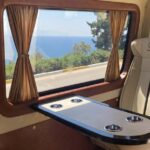
One more practical win: the tour includes transport by air-conditioned minivan. In Turkey in warm months, that simple comfort can make a big difference. You’re still outside a lot, but you get proper breaks in the air-con between stops.
You can also read our reviews of more tours and experiences in Kusadasi.


Ephesus Ancient City: from Magnesia Gate toward the Harbor
The Ephesus walking tour focuses on the city’s most famous streets and buildings. You begin at the Upper Magnesia Gate, then work your way down the historic spine of the city toward the harbor area. The route isn’t random sightseeing. It’s arranged so you can see the scale of the Roman-era city and also how Greek and Roman layers overlap.
Along the way, you’ll see stops that make Ephesus feel real instead of like a pile of columns:
- The Odeon, an ancient venue that gives you a feel for public performances
- The Fountain of Trajan, a landmark that shows how civic life and water systems worked
- The steam baths of Scholastika, which points to daily life for people with real routines
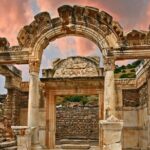
- The Temple of Hadrian, tying the site to emperors and official power
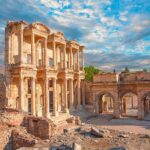
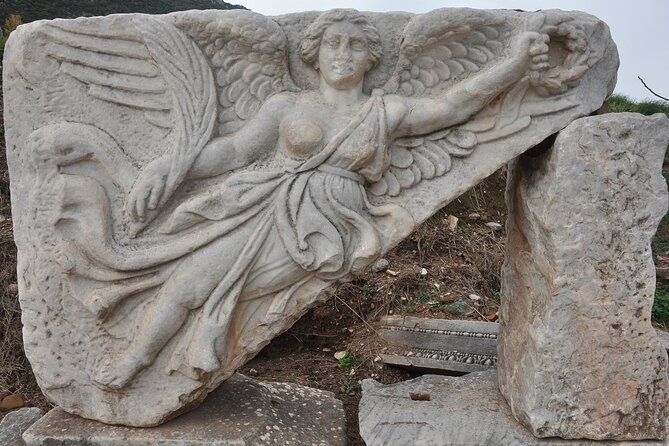
- The Library of Celsus, one of the most visually striking ruins in the complex
Here’s the value of a guided “highlights” route: someone points out what to notice. You learn what each building was for, and you also learn how the city’s layout shaped movement. Without that, Ephesus can turn into “I recognize a few photos, now what?”
One caution: Ephesus ruins do not move. Your pace does. If you’re prone to stopping often for photos, plan to keep your stops tight, or you’ll feel rushed later.
The Library of Celsus and the Grand Theater you shouldn’t rush past
Two landmarks are doing heavy lifting on this itinerary: the Library of Celsus and the Grand Theater.
The Library of Celsus is famous for its façade details—columns, statues, and the kind of symmetry that still looks impressive even after centuries of weathering. It’s one of those places where, even if you don’t know every term a guide might mention, you can still “read” the design. You’ll understand quickly why this stood out to ancient visitors.
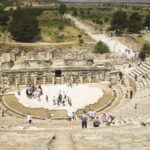
Then comes the Grand Theater. This is where the tour turns from architecture to story. The theater is noted as the largest in antiquity, with a capacity around 24,000 seats, and it’s linked to St. Paul’s preaching. You don’t need to be a history buff to feel the scale here. Stand where the audience would have been and look toward the stage area, and suddenly the space makes sense.
If you care about comfort, do a quick body check before you enter the theater areas. Expect steps and uneven ground. Bring water if allowed by the tour rules for your day, and wear shoes with solid grip.
Meryemana (Mary’s House): a calmer stop between monuments
After the Roman city’s energy, Meryemana (The Virgin Mary’s House) offers a different pace. It’s located in a nature park between Ephesus and Selçuk, and it’s considered sacred by both Christians and Muslims. That shared reverence is part of what makes the site feel less like a box of ruins and more like a place people still relate to.
This stop is only about 30 minutes, so you won’t have time to linger for a long sit-down meditation or to wander endlessly. But you do get a meaningful break from the heat and crowds typical of large archaeological sites.
One practical tip: treat this as a “reset” stop. Use it to regroup, hydrate, and slow your camera pace. If you go in thinking of it as a quiet pause rather than another photo sprint, you’ll get more out of it.
Temple of Artemis ruins: the Seven Wonders connection in 30 minutes
The Temple of Artemis stop is short, but it’s still worth it because it’s tied to one of the most famous cultural references in the ancient world. The temple’s story goes back to the Archaic period, and it’s counted among the Seven Wonders of the Ancient World.
Now, here’s the reality check: you’re looking at ruins, not a restored temple you can walk through like a modern building. So your payoff comes from scale and context rather than walking around inside. A good guide helps you connect what’s left to what once stood here, and that makes the visit feel clearer.
If you’re into mythology, religion, and how cities marketed themselves through major landmarks, this is a nice cap to the Ephesus day. Artemis gives you a different angle on the region’s importance, beyond the Roman-era streets you saw first.




Getting there comfortably: pickup, minivan, and skip-the-line entry
Logistics can make or break a cruise-day excursion. This one includes port pickup and drop-off in an air-conditioned vehicle, plus admission tickets for each stop. The big time-saver is the guaranteed skip the long lines, which helps when you’re on a schedule and there are lots of other buses in the area.
The tour is also built around mobile efficiency: you’ll use a mobile ticket. That matters more than it sounds. It saves time at check-in and reduces the chance you end up stuck sorting paperwork at the wrong moment.
That said, skip-the-line doesn’t mean you’ll be alone. You can still expect other groups at popular ruins, especially on cruise shore days. The difference is that you’re less likely to spend your limited half-day waiting behind people who showed up late or who didn’t have tickets ready.
Lunch included: what you should plan for
Lunch is included, which is a strong value signal for a half-day tour. When you’re touring sites all morning, meals can become an expensive hassle if they’re not handled for you.
There’s one small catch: coffee or tea isn’t included. If you like a drink with lunch, budget for it. Also, because your total time is limited, you’ll likely need to treat lunch as part of the schedule, not a leisurely stop.
My practical advice: check what you’ll wear and pack so you’re ready to eat without slowing everything down. That means easy-to-reach water bottles (if permitted), sunglasses, and a light layer if you get chilly during transport.
Price and value: $190 per person, and what you’re really paying for
Let’s talk money with clear eyes. $190 per person is not bargain-basement, but it also isn’t “only the driver gets paid” pricing. Here’s what’s bundled:
- Transport by air-conditioned minivan
- Professional guide
- Port pickup and drop-off
- Local taxes
- Admission tickets for the key stops
- Lunch
- Guaranteed skip-the-line entry
- Group discounts (so the per-person cost can improve depending on your party)
When you compare that to doing it independently, the big cost isn’t just tickets. It’s time and coordination. Ephesus is spread out, entry lines can eat your schedule, and a half-day disappears fast once you’re negotiating transit and finding meeting points.
This is also a reasonable choice if you want a guided narrative. The guide’s job here isn’t just pointing at stones. It’s connecting the sites into a story—Roman urban life, earlier Greek roots, and later religious meaning at Meryemana.
Who this tour suits best (and who might want a longer day)
This tour fits best if you want a tight, high-impact Ephesus orientation without turning it into a full-day endurance test. It’s especially good for:
- First-time visitors to Ephesus
- Cruise passengers who need a controlled schedule
- People who value a guide to explain what they’re looking at
- Anyone who prefers fewer logistics and an organized meal
It may not be the best match if you want deep museum-style time. This is highlights, not a slow wander. You’ll see major landmarks, but you won’t have hours to explore every alley, side ruin, or smaller detail.
One more note that matters: the tour asks for moderate physical fitness. That usually translates to uneven ground, stairs, and heat exposure, even if the stops are only 2 hours, 30 minutes, 30 minutes.
A quick word on guides and shopping stops
One of the strengths of tours like this is how the guide makes the city click. In past experiences tied to this region, guides such as Eylem Rehbecom have been praised for being fun, approachable, and easy to follow. A good guide is especially helpful at Ephesus, where it’s easy to feel lost without a route.
Also, I’ll flag something practical for your decision-making: some Ephesus-area tours add shopping stops like rugs or jewelry. This tour’s stated agenda centers on Ephesus, Mary’s House, and Artemis, with lunch included. Still, if shopping matters to you either way, confirm whether any extra stops are optional on your departure day.
Should you book this Ephesus Highlights Tour?
I’d book it if you want your first Ephesus visit to feel organized, guided, and time-friendly. The combination of skip-the-line, included admissions, port pickup/drop-off, and a guided route through the most famous landmarks is a strong value for a half-day.
I’d be cautious if you’re hoping for a slow, fully relaxed pace or if you have limited comfort with walking on uneven stone. In that case, you might prefer a longer tour with more sitting time and more room to wander off the main path.
If your priority is getting the big Ephesus hits, plus Meryemana and Artemis, this tour delivers a clean, efficient route with the logistics handled.
FAQ
How long is the Ephesus Highlights Tour?
The tour runs about 4 to 5 hours.
Where does the tour start and end?
It operates from Kusadasi, Turkey, with port pickup and drop-off included.
What sites are included?
You’ll visit the Ancient City of Ephesus, Meryemana (The Virgin Mary’s House), and the Temple of Artemis ruins.
Are admission tickets included?
Yes. Admission tickets are included for the Ephesus stop and also for Meryemana and the Temple of Artemis.
Is lunch included?
Yes, lunch is included. Coffee and/or tea are not included.
Is this tour private?
Yes. Only your group will participate.
What if I miss the tour because of late cruise arrival?
Refunds will not be issued if the tour/activity is missed due to late or non-arrival of the cruise ship. You should share your cruise ship name and docking, disembarkation, and re-boarding times when booking.